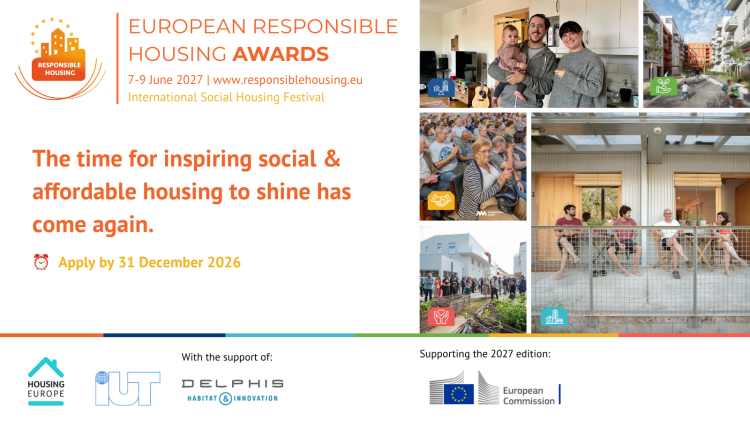
The 6th European Responsible Housing Awards are taking place on 7-9 June, 2027 in Lisbon, with the support of the European Commission. The award ceremony will take place during the International Social Housing Festival – a global event that brings over 1,000 social and affordable housing providers, policymakers, tenants, urbanists, architects, researchers, journalists, and activists. For this year's edition, the organisers are expecting over 2,400 delegates!
The Awards winners and finalists set an example of how homes and neighbourhoods can be sustainable, affordable, beautiful and bring people together all at once. Winning projects include successfully engaging tenants in decisions, ensuring proximity to services and jobs, offering information, and training, and ensuring long-term affordability and security.
Why take part in the Awards? Because it offers well-deserved recognition for going the extra mile, it represents an occasion to network with like-minded practitioners and experts, and it gives the opportunity to advocate in the name of the sector for more action to be taken.
The European Responsible Housing Initiative (ERHIN) has been a project implemented by DELPHIS, Housing Europe and the International Union of Tenants, co-funded by the European Commission (DG Enterprise). The project was carried out between April 2013 and October 2014, with a view to lead the way towards better embedding Corporate Social Responsibility (CSR) in the public, cooperative, and social housing sector, through awareness-raising, transfer of knowledge and tools and stakeholder dialogue at European level.
- Who can participate in the Awards?
The applications are open to the social and affordable housing sector and to the hybrid sector (public + private), but they are NOT open to the private for-profit sector. Municipalities, if housing providers, are also welcome to apply.
- Which languages are accepted for the application?
Only English is accepted. Applications submitted in another language will not be evaluated.
- What is the deadline for submissions?
The deadline for submissions is 31 Dec 2026.
- What are the evaluation criteria of the applications?
The Jury is paying particular attention to the following aspects:
- Stakeholder dialogue and Partnerships: How were stakeholders involved in the design and implementation of the housing project?
- Awareness-raising and leadership: To what extent does it contribute to raise awareness on CSR, responsible housing and sustainable development?
- Transparency and accountability: To what extent is the organisation transparent/accountable on its commitments, actions and results relating to the proposed good practice?
- Operational implementation: Were some specific tools developed/used? How replicable are they?
- Assessment of the shared value created: To what extent/how was the impact assessed?
- To what extent is the project innovative? The Jury will assess the novelty of the project and to what extent does it use new approaches and/or technology to meet housing needs.
- What are the categories of the Awards?
The Categories of the Awards will be based on the Code of Conduct and will thus be:
1. Fair Financing for Housing Affordability and Economic Responsibility
- Invest sustainably, ensuring cost-effectiveness and balancing the level of services provided, the related costs and how far current and prospective tenants/residents can afford them, thus minimizing housing costs.
- Together with tenants/residents, endeavour to ensure that innovative energy saving measures improve the affordability of total housing costs, including energy costs, and the comfort of dwellings.
- Invest in affordable housing on the long-term, contributing to more stable housing markets, thereby mitigating the negative effects of real estate speculation.
- Support responsible procurement practices and local economic growth and employment through partnerships, research, knowledge sharing, capacity building and innovation.
- Implement innovative and scalable financing models at an organisational, regional or national level that support the long-term provision and renovation of affordable housing, including revolving funds, guarantee schemes and other mechanisms that mobilise investment while preserving affordability.
2. More than a Roof – Local Social sustainability for communities
- Ensure decent, accessible housing is available at an affordable cost, and will remain so in the future.
- Manage the housing stock so that homes are well maintained adapted to changing demographic needs, with repairs and improvements carried out when required, involving tenants/residents in the decision process.
- Ensure security of tenure based on fair and safe tenancy agreements, and work with partners to help residents, particularly vulnerable groups, access the support they need to stay in their homes.
- Make sure to meet the diversity of households’ needs, including those of the most vulnerable and persons with disabilities, through accessible and inclusive housing solutions, treat fairly each current and prospective tenant/resident, and prevent all forms of discrimination.
- Work together with local authorities and other stakeholders to guarantee fair access to housing and related services, and that housing allocation increases social mix.
- Work together with local authorities and other stakeholders at local level to promote innovative, socially cohesive and inclusive neighbourhoods, and fight social and spatial segregation.
3. Leaders of Innovation for a Fair Energy Transition
- Reduce the environmental footprint of our housing stock through construction, retrofitting and the transformation of existing buildings, to the highest standard possible, in a cost-effective way for both providers and tenants/residents.
- Cooperate with tenants/residents and their representative organisations to reduce energy consumption in our buildings and reduce energy poverty, to prevent pollution and promote a sustainable use of natural resources.
- Include green infrastructures, nature-based solutions and common green spaces in our estates and build partnerships with other organisations to create environmentally sustainable and resilient neighbourhoods.
- Promote climate change mitigation and adaptation through resilient buildings, neighbourhoods and infrastructure that can respond to changing environmental conditions.
- Deploy innovative and resource-efficient construction, renovation and management solutions, including industrialised construction methods, circular approaches, digital tools, artificial intelligence and other emerging technologies, while strengthening the skills and capacities needed to deliver sustainable and climate-resilient housing.
4. Building Strategic Alliances and Fostering Community Participation
- Ensure good communication and transparency on how and why decisions are taken, as well as on expenses and services provided.
- Work in partnership with local authorities so that those who are looking for a home are aware and well informed on available possibilities, and handle the allocation process transparently.
- Support greater stakeholders’ engagement and real partnerships, based on mutual commitments and clear roles and responsibilities, and co-creation.
- Strengthen institutional and structured participation of tenants/residents, and facilitate this proces by providing them with the necessary knowledge and information and capacity-building opportunities.
- Ensure accountability towards the different stakeholders and opportunities for feedback, joint learning, and evaluation and assessment of the activities carried out, as well their impact.
5. Going the Extra Mile for Housing the Youth
- Develop innovative, affordable quality and well-located housing for young people, including students, young workers and those entering independent living.
- Promote housing models that combine affordability, sustainability, quality and long-term security of tenure.
- Support housing stability through innovative partnerships, financing mechanisms and housing management approaches.
- Co-management and co-design of young residents in shaping housing services, communities and neighbourhoods.
- Showcase initiatives that contribute to attracting young people by creating inclusive, vibrant and affordable places to live.
- Promote intergenerational living through housing models that strengthen solidarity and mutual support between generations.
- Who to contact in case of further questions?
Please send an email to hello@responsiblehousing.eu. We will be happy to answer you.
- How is the Jury composed?
The Awards Jury is composed of members of the European Responsible Housing Stakeholder Forum set up in the framework of the ERHIN Project as well as experts in CSR from other sectors. For more information.
- When will the European Responsible Housing Awards be celebrated?
The final ceremony of the European Responsible Housing Awards will take place during the International Social Housing Festival (June 2027).
 Entries open
Sign up for this award
Submit your projectOther editions
 Closed
Start date of registration 16 October 2024
End date of registration 19 February 2025
European Responsible Housing Awards 2025
 Closed
Start date of registration 13 September 2021
End date of registration 06 February 2022
European Responsible Housing Awards 2022
 Closed
Start date of registration 23 November 2018
End date of registration 03 March 2019
European Responsible Housing Awards 2019
 Closed
Start date of registration 14 March 2016
End date of registration 01 June 2016
European Responsible Housing Awards 2016
 Closed
Start date of registration 14 February 2014
End date of registration 14 May 2014
European Responsible Housing Awards 2014